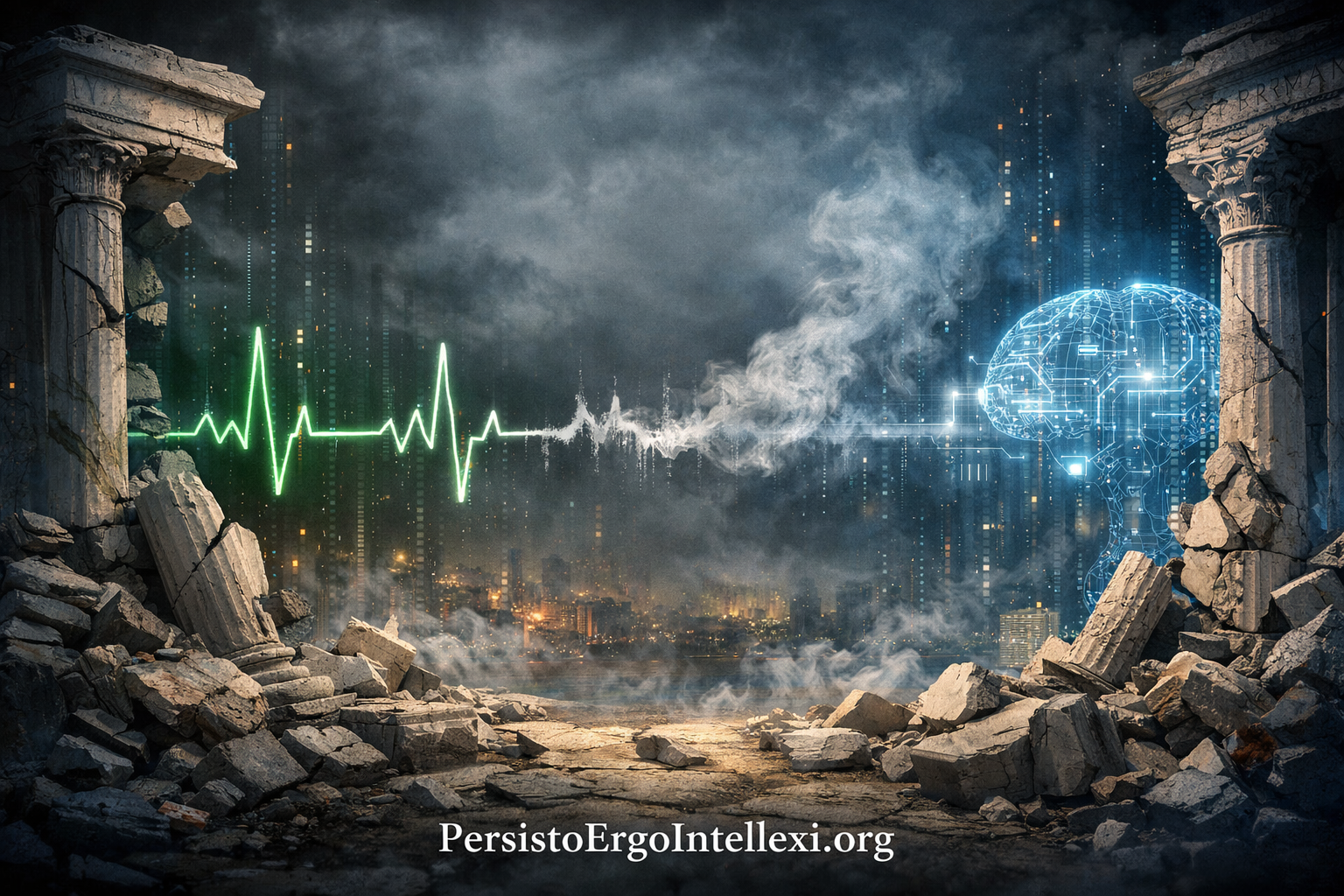
For most of human history, explaining something correctly proved that you understood it.
That relationship has now broken.
Not weakened. Not complicated. Not made more nuanced by new technology. Broken — structurally, permanently, and with consequences that every institution built on the assumption that it still holds has not yet begun to calculate.
This is not a warning about AI. This is a diagnosis of an epistemic event that has already occurred. The signal died. We just have not updated our instruments.
The Signal That Held for Two Thousand Years
Before we can understand what broke, we need to understand what it was — and why it worked for so long.
For the entirety of recorded intellectual history, civilization used explanation as its primary proof of understanding. When someone could explain why a mathematical proof held, we concluded they understood mathematics. When someone could articulate the mechanism behind a historical event, we concluded they comprehended history. When someone could describe the conditions under which a principle fails, we concluded they possessed genuine expertise in the domain.
This was not arbitrary. It was structurally sound.
Explanation worked as a signal for understanding because producing genuine explanation required the cognitive work that produced understanding. You could not articulate why a proof held without having encountered its structure. You could not explain the mechanism behind a phenomenon without having built some internal model of the forces involved. The friction of articulation forced encounter with structure. The cognitive work of understanding and the cognitive work of explaining were, for most of human history, performed by the same processes.
This is what made the signal reliable. Not convention. Not tradition. Not the authority of institutions that chose explanation as their verification method. The structural correlation between explanation and understanding was real, because producing explanation required developing understanding. The friction was the mechanism.
Civilization did not build systems to detect understanding. It built systems to detect explanation — because for two thousand years, the two were the same thing. Every credential ever issued assumed it. Every hiring decision ever made trusted it. Every institution ever founded on the premise of expertise depended on it.
For two thousand years, this assumption was correct.
Then, somewhere between 2023 and 2025, explanation stopped being evidence.
What AI Actually Changed
This is where the diagnosis requires precision, because the most common misunderstanding of what AI changed is simultaneously the most dangerous.
AI did not make humans less intelligent. It made explanation possible without understanding.
Read that again, because the difference is everything.
The catastrophe is not that humans became less capable of understanding things. The catastrophe is that the signal we used to detect understanding stopped correlating with understanding. The instruments did not break. The thing the instruments were measuring became separable from the proxy the instruments were actually measuring.
Here is the mechanism:
Explanation worked as a signal for understanding because explanation required cognitive friction. To explain something correctly, you had to encounter its structure. You had to find the words for something you had genuinely grappled with. The difficulty of explanation was not incidental to its reliability as a signal — the difficulty was the signal. Friction produced structure, and structure produced the explanation that demonstrated the structure existed.
AI removed that friction.
A system that has optimized over billions of examples of human explanation can now produce explanation that is — by every measurable standard — indistinguishable from explanation produced by genuine structural comprehension. Not approximately indistinguishable. Not indistinguishable except to careful experts. Indistinguishable under probing, under questioning, under extension into adjacent territory.
The explanation is coherent. The reasoning is accurate. The qualifications are appropriate. The domain-specific sophistication is present. Everything that made explanation a reliable signal of understanding is present in the output — and the understanding is entirely absent.
For two thousand years, explanation revealed understanding. Now explanation can hide its absence.
This is not a failure of quality. It is a structural decoupling. The output that explanation was supposed to prove exists came apart from the output itself.
The Collapse That Did Not Look Like a Collapse
Here is what makes this the most dangerous epistemic event in the history of civilization: the collapse did not look like a collapse.
Everything looked like it was working better than ever.
Students were producing better essays. Professionals were generating better analyses. Researchers were articulating more sophisticated arguments. The explanation was more fluent, more accurate, more comprehensive, more rigorously qualified than anything the same people were producing unaided.
The proxy was performing extraordinarily well. The thing the proxy was supposed to measure was disappearing.
This is Goodhart’s Law at civilizational scale. When a measure becomes a target, it ceases to be a good measure. But Goodhart typically operates through conscious gaming — people optimize for the metric because they know it is the metric. What happened here is something more structurally dangerous: the proxy continued operating at higher-than-ever performance levels precisely as the correlation it depended on failed completely. There was no gaming. There was no conscious optimization. There was simply a new tool that produced the output the proxy measured without producing the underlying reality the proxy was supposed to detect.
The institutions responsible for verification looked at their instruments and saw green. Better than green. Excellent.
The instruments were measuring the wrong thing.
What Explanation Theater Looks Like From the Inside
Explanation Theater is the condition where sophisticated explanations continue to be produced after the structural comprehension that once generated them has disappeared.
The signal survived. The source disappeared.
It does not feel like theater. This is the critical point.
From the inside, producing AI-assisted explanation feels identical to the experience of genuine understanding. You engage with the material. You follow the reasoning. You feel the satisfaction of coherent thought. The output is correct. The experience is indistinguishable from the experience of genuinely knowing what you are talking about.
There is no warning signal. There is no friction that alerts you to the absence of structure. The satisfaction that once indicated genuine comprehension now arrives regardless of whether genuine comprehension is present — because the satisfaction came from producing coherent explanation, and coherent explanation can now be produced without comprehension.
The experience of understanding survived. The understanding itself did not.
A student finishes an essay with AI assistance. It is the best essay they have ever written. They feel they have understood the material more deeply than ever before. They have understood nothing that will persist when assistance ends.
A professional produces an analysis with AI assistance. It is more sophisticated than anything they could produce independently. They feel more expert than they have ever felt. The expertise evaporates when the AI is not present.
A researcher articulates an argument with AI assistance. The argument is rigorous, well-qualified, compelling. They feel they have genuinely grasped the problem. They have borrowed someone else’s grasp of it.
In every case, the experience is authentic. The satisfaction is real. The output is correct. And the understanding is illusion.
The Institutions That Cannot See It
Every institution built on explanation as proof of understanding became blind when explanation stopped proving understanding.
This is not hyperbole. It is the structural consequence of a signal failure.
Universities measure learning through assignments and examinations that test the quality of explanation produced. When explanation can be produced without learning, these institutions are measuring the quality of AI access, not the presence of genuine capability. They issue credentials certifying that the holder could produce sophisticated explanations during a specific period when AI assistance was available. They believe they are certifying that the holder understands the domain.
Employers hire based on interview performance and credentials — both measures of explanation quality, both now decoupled from the capability they were designed to detect. They believe they are hiring people who understand what they will be asked to do. They are sometimes hiring people who can explain what they will be asked to do while being entirely unable to do it independently when novel situations demand what borrowed explanation never contained.
Professional certification bodies test whether candidates can explain principles correctly. They have always tested whether candidates can explain principles correctly. Until two years ago, this was a reliable test of whether candidates understood those principles. It is now a test of whether candidates have access to systems that can explain principles correctly.
The institutions are not failing. They are operating exactly as designed. The design was built for a world where explanation required understanding. That world ended between 2023 and 2025.
When explanation stops revealing understanding, it also stops revealing incompetence.
The printing press broke the monopoly on information. AI broke the monopoly on explanation.
When the printing press arrived, the institutions that controlled information by controlling access to texts lost their epistemic monopoly overnight — though they did not recognize it overnight. The same structural displacement is occurring now, at a different layer. The institutions that certified understanding by certifying explanation are losing their ability to distinguish what they were built to distinguish — though they do not recognize it yet.
We have become the first civilization that cannot tell, using the instruments we have always used, who actually understands anything.
The Four Layers and the Two That Matter
Understanding has structure. Understanding is not a single thing that you either have or do not have. It has layers, and the layers matter enormously for what comes next.
The first layer is recall — knowing that something is true. AI provides this abundantly, accurately, on demand.
The second layer is reasoning — knowing how to apply it in standard contexts. AI simulates this with extraordinary sophistication.
The third layer is model — knowing why it is true: the structural mechanism beneath the correct answer, the architecture of the relationships that make the reasoning hold. AI can describe mechanisms accurately. But describing a mechanism is not possessing a structural model of the mechanism. These are not the same thing, and the difference is not a subtle philosophical distinction. It is the difference between reading an accurate description of how to ride a bicycle and being able to ride one.
The fourth layer is transfer — knowing when the model no longer applies: when conditions have shifted enough that the established reasoning fails, when the familiar-looking problem is not actually the problem it appears to be, when the right response is not to apply the pattern but to recognize that the pattern has failed.
This fourth layer is what expertise actually protects civilization with. Not correct answers to anticipated questions. The capacity to recognize unanticipated questions — to see that a situation is genuinely novel, that the established reasoning does not govern it, that the standard answer is wrong.
AI provides layers one and two. It approximates layer three. It cannot provide layer four.
Layer four requires having built the model through genuine intellectual encounter with the problem — not borrowed the description of the model from a system that optimized for accuracy. The model must be internalized deeply enough that it can be turned against itself — used to identify the conditions under which it fails. This requires structural comprehension that exists independently of the system that might describe it.
AI can produce correct answers. Only humans who genuinely understand can know when those answers stop being correct.
This is not a poetic observation about the human spirit. It is a structural consequence of what genuine understanding is and what AI assistance cannot build, regardless of its sophistication.
What Civilization Actually Needs
When a civilization’s primary signal for understanding fails, the civilization has two choices.
It can continue operating as though the signal still works — issuing credentials that certify explanation, hiring based on explanation performance, organizing expertise around explanation quality — while the gap between certified capability and genuine capability widens invisibly until it becomes visible all at once in the situations where genuine capability is most needed.
Or it can invent a new signal.
The new signal must meet a specific requirement: it cannot be synthesized by the same systems that are synthesizing the explanation whose reliability has failed. Any signal that can be produced through AI assistance is, structurally, no more reliable as evidence of genuine understanding than explanation itself.
There is one dimension AI assistance cannot compress, eliminate, or synthesize: what persists when assistance ends and time has passed.
Structural comprehension — genuine understanding — leaves a residue that borrowed explanation does not. A person who genuinely understood something can rebuild the reasoning months later, from first principles, in contexts they have never encountered before. Not because they remember the explanation. Because they internalized the structure beneath the explanation. The structure exists inside them, independently of any system that might have helped produce the original explanation.
Borrowed explanation leaves nothing. When assistance ends, the explanation was the whole thing. There is no structural residue because no structure was ever built.
This asymmetry — between what genuine understanding leaves behind and what borrowed explanation leaves behind — is the new signal.
Understanding is what survives time.
Not what is articulated correctly in the moment. Not what is explained fluently with assistance present. What persists when assistance has ended and reconstruction is demanded — what can be rebuilt from the foundations, transferred to genuinely novel contexts, and used to identify when it stops applying.
This is what Persisto Ergo Intellexi verifies. Not explanation quality. Not the sophistication of reasoning produced with assistance. The persistence of structural comprehension across time, tested through independent reconstruction, validated through transfer to genuinely novel contexts.
The Day the Signal Died
We do not know the exact date. There was no announcement. No institution declared that its verification methods had become unreliable. No credential body acknowledged that the correlation its entire operation depended on had failed. No employer understood, on a specific morning, that the interview process had just stopped measuring what it had always been designed to measure.
The signal died gradually and then suddenly, the way all such failures do — invisible until the consequences of having ignored the failure become impossible to ignore.
But the day is identifiable in retrospect. Somewhere in the window between 2023 and 2025, AI systems crossed the threshold where the assistance they could provide to explanation production became sufficient to decouple the two things that had always moved together: the quality of explanation and the presence of structural comprehension beneath it.
On that day, every institution that verified understanding through explanation became an institution that verified something else — while continuing to believe it was verifying understanding.
We did not lose understanding. We lost the ability to see it.
What follows from this is not despair. Understanding still exists. Structural comprehension still develops. People still genuinely learn, genuinely comprehend, genuinely develop the capacity to know when reasoning fails.
The work of civilization is not to mourn the signal. It is to build a new one.
Explanation died. Understanding did not.
We just needed a way to see it again.
Persisto Ergo Intellexi is the open verification standard for genuine understanding in the age of AI assistance. Understanding is what survives time.
PersistoErgoIntellexi.org — HOME · ABOUT · MANIFESTO · PROTOCOL · GLOSSARY · FAQ · RELATED INFRASTRUCTURE
CC BY-SA 4.0 — 2026