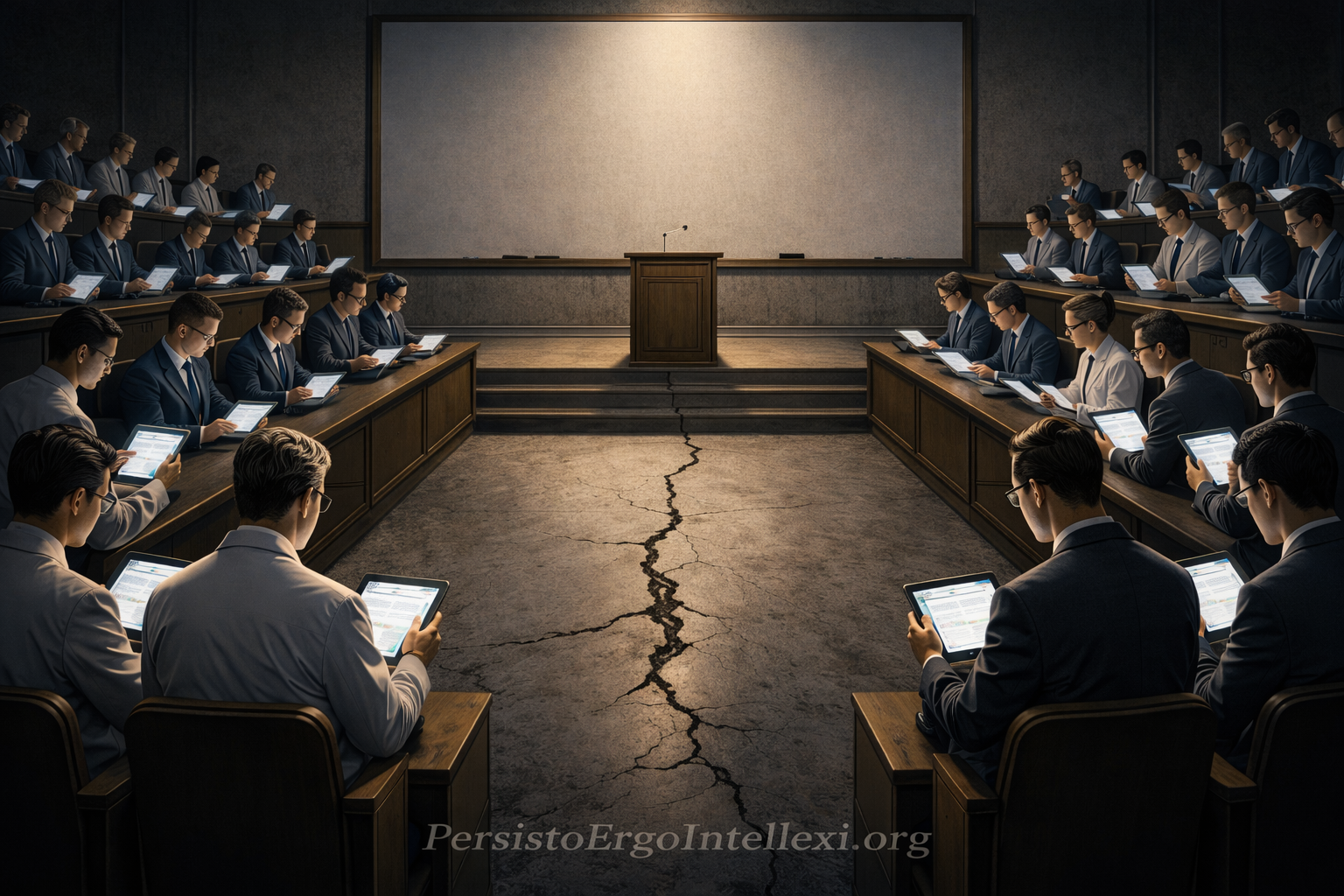
For the first time in human history, a profession can fill itself with people who can perform expertise without possessing it.
This is not a warning about the future. It is a description of what is already happening — quietly, systematically, and in ways that are invisible to every instrument civilization currently uses to detect it.
The Expertise Illusion is not about dishonesty. It is not about people pretending to know things they do not know. It is about something structurally more dangerous: people genuinely believing they possess understanding they have never developed — and institutions genuinely believing them.
Borrowed explanation performs perfectly. Until the moment it is needed most.
What Expertise Actually Is
Before we can diagnose the illusion, we need to be precise about what expertise actually is — because most institutions have been measuring the wrong thing for long enough that the measurement has become the definition.
Expertise is not the accumulation of accurate information. Layer One — recall — can be provided on demand by any AI system with internet access.
Expertise is not the ability to apply established methods to recognized situations. Layer Two — reasoning — is simulated with extraordinary sophistication by AI systems trained on the entirety of documented human problem-solving.
Expertise is not even the ability to describe the structural mechanisms beneath correct answers. Layer Three — model — can be articulated accurately by any system that has processed enough expert explanation of those mechanisms.
Genuine expertise is Layer Four: the structural capacity to recognize when the established reasoning fails. Not applying the correct answer — recognizing when the correct answer is wrong. Not following the right protocol — detecting when the right protocol does not govern this situation. Not extending the established pattern — seeing that the pattern has ended and something genuinely different is occurring.
Expertise is not the ability to produce answers. It is the ability to recognize when answers stop working.
This is what expertise has always been for. Not the typical case — the typical case can be handled by protocol and procedure. Expertise protects civilization at the boundary: the atypical presentation, the unprecedented failure mode, the novel situation that resembles familiar ones in every surface feature while differing from them in the structural features that determine the correct response.
Civilization does not run on Layer One, Two, or Three. It runs on Layer Four. And Layer Four is the only layer that cannot be borrowed.
How the Illusion Forms
The Expertise Illusion does not form through laziness or deception. It forms through a structural property of AI assistance that makes it impossible to detect in the moment of acquisition.
When a person engages with material through AI assistance — producing analyses, developing arguments, explaining mechanisms — the experience is phenomenologically identical to the experience of genuine understanding. The satisfaction of coherent reasoning arrives. The feeling of comprehension is authentic. The output is correct, sophisticated, and defensible.
What does not arrive is the structural residue that genuine intellectual encounter leaves behind: the internalized model that can be rebuilt from first principles, tested at its edges, and used to identify the conditions under which it fails.
Borrowed explanation leaves no structural residue. The reasoning existed in the system that produced it. The person who articulated it experienced the satisfaction of understanding without building the structure that understanding is.
When explanation becomes frictionless, expertise becomes theatrical.
This is not a moral failure. It is an information-theoretic property of AI-assisted cognition: the satisfaction signal that historically indicated genuine comprehension now fires regardless of whether genuine comprehension occurred. The internal experience provides no information about whether Layer Four was developed. Only temporal testing — months later, without assistance, in genuinely novel contexts — reveals the difference.
The Expertise Illusion is therefore not visible to the person experiencing it. They are not performing competence they know they lack. They genuinely believe they have developed the structural comprehension that their performance suggests. The belief is sincere. The belief is wrong.
What Institutions Cannot See
The Expertise Illusion would be dangerous even if it only affected individuals. It becomes civilizationally dangerous because institutions cannot see it either.
Every institutional mechanism for verifying expertise was designed for a world where explanation required structural comprehension — where the cognitive difficulty of producing genuine expertise-level explanation filtered out those who lacked the underlying understanding. Interviews test explanation quality. Credentials certify explanation production during assessment periods. Peer review evaluates the sophistication of articulated reasoning. Performance reviews measure output quality.
All of these mechanisms are now measuring the wrong thing.
They were built on a correlation that held for the entirety of their existence: that producing expert-level explanation required possessing expert-level structural comprehension. That correlation has been broken. Expert-level explanation can now be produced without the structural comprehension that makes it genuine expertise — and every institutional filter that depended on this correlation is now detecting the presence of AI access rather than the presence of genuine understanding.
The danger is not that individuals mistake performance for understanding. It is that institutions do.
A hospital credentialing committee evaluates whether a physician can explain diagnostic reasoning. It cannot evaluate whether the physician has developed the structural comprehension that would allow them to recognize when established diagnostic reasoning fails in an atypical presentation.
A law firm’s hiring process assesses whether a candidate can articulate sophisticated legal arguments. It cannot assess whether the candidate has developed the structural comprehension that would allow them to see when established legal reasoning produces the wrong answer in a genuinely novel case.
An engineering firm’s certification process verifies whether candidates can demonstrate correct application of structural principles. It cannot verify whether candidates have developed the structural comprehension that would allow them to recognize when those principles do not govern a specific failure mode.
In every domain where expertise is protective, institutional verification now certifies Layer Two and Three performance. Layer Four — the only layer that matters when conditions change — is invisible to every instrument these institutions possess.
Credentials once certified understanding because explanation required it. Today, credentials certify the ability to produce explanation.
The Professions
The Expertise Illusion is not evenly distributed across domains. It concentrates precisely where the cost of Layer Four absence is highest.
Medicine
A physician operating within established diagnostic categories and treatment protocols is largely operating at Layer Two and Three. AI assistance can augment this performance substantially without compromising outcomes in typical cases.
The physician’s irreplaceable contribution is the atypical case — the patient whose presentation resembles a familiar diagnosis but deviates from it in ways that indicate a different underlying mechanism. Recognizing this deviation requires Layer Four: the structural comprehension of pathophysiology deep enough to see that the established pattern does not govern this presentation, that the standard answer is wrong, that something genuinely different is occurring.
A physician who has developed genuine structural comprehension of pathophysiology can detect this. A physician who has borrowed explanation — who has produced sophisticated clinical reasoning without developing the internal model that makes it genuinely theirs — cannot. Both will handle typical cases identically. Only the atypical case reveals the difference.
The atypical case is where patients die.
Engineering
Structural, mechanical, and software engineering operate through established principles whose application to standard cases can be verified procedurally. AI assistance can substantially augment performance within the distribution of standard cases.
The engineer’s irreplaceable contribution is the novel failure mode — the situation that falls outside the distribution, where established principles apply in unexpected ways or fail to apply at all. Recognizing this requires Layer Four: structural comprehension of the underlying physics or logic deep enough to see that the established approach will fail here for reasons that are not visible in the surface features of the problem.
The engineer who borrowed their understanding of structural mechanics can design correctly within established parameters indefinitely. The failure appears at the boundary — in the novel load case, the unexpected material behavior, the emergent interaction between systems that no established protocol anticipated.
The pattern holds perfectly — until the moment it doesn’t, and by then the failure is already in motion.
Novel failure modes do not announce themselves. They look like typical cases until they do not.
Law and Governance
Legal and policy expertise operates through precedent and established frameworks. AI assistance can produce sophisticated legal reasoning, identify relevant precedent, and articulate arguments that are indistinguishable from expert legal analysis in standard cases.
The lawyer’s and policymaker’s irreplaceable contribution is the genuinely novel case — the situation that raises questions no precedent governs, where the structural purpose of existing frameworks must be understood deeply enough to determine whether and how they apply. This requires Layer Four: comprehension of why the legal principles exist, not just how they have been applied.
Borrowed legal expertise fails silently in novel cases — producing confident arguments built on pattern extension that stops at exactly the point where genuine structural comprehension would recognize the pattern has ended.
The law does not break loudly. It breaks quietly, through arguments that sound correct but are structurally wrong.
Leadership and Strategy
Organizational leadership and strategic decision-making operate largely through established frameworks, historical analogies, and documented best practices. AI can produce sophisticated strategic analysis that is indistinguishable from expert thinking in stable conditions.
The catastrophic failure of leadership expertise is the genuinely novel crisis — the situation that superficially resembles familiar strategic contexts while differing from them in the structural features that determine which response is correct. Applying the right strategic framework to the wrong situation is not just ineffective. It actively prevents recognition that a different situation is occurring.
Leadership collapses not from lack of intelligence, but from lack of Layer Four.
Professions do not collapse because experts make mistakes. They collapse because no one can recognize the mistake.
The Silence Before the Failure
What makes the Expertise Illusion so structurally dangerous is the temporal architecture of its failure.
The absence of Layer Four is invisible during normal conditions. A professional whose structural comprehension is entirely borrowed performs identically to one with genuine expertise in every situation the training distribution covers — which is most situations, most of the time. The credentials are real. The performance metrics are excellent. The explanation quality is high. Every contemporaneous instrument shows green.
The failure appears at the novelty threshold: the moment when conditions shift enough that established patterns fail to govern the situation. This moment arrives without announcement. It looks like a typical case until it does not. And when it does not, the professional who borrowed all their structural comprehension has no Layer Four to detect what is happening.
Expertise fails quietly before it fails catastrophically.
By the time the failure is visible, the consequences have already occurred. The misdiagnosis has been made. The structural failure has been initiated. The legal argument has been filed. The strategic decision has been implemented. The moment that required Layer Four has passed, and it passed without Layer Four being present.
This is the architecture of civilizational risk: normal conditions produce no signal of the deficit, the deficit reveals itself precisely when it is most consequential, and the institutions responsible for verification had no instrument capable of detecting it before the moment of failure.
The difference between performance and understanding is invisible during normal conditions. It appears only when conditions change.
What Persisto Ergo Intellexi Reveals
Temporal verification does not test whether practitioners can produce expert-level explanation. It tests whether the structural comprehension that would generate genuine expertise has been developed — whether Layer Four exists independently of the assistance that may have been present during training and assessment.
The test is simple in principle: months after training, with all assistance removed, in genuinely novel contexts, can the practitioner recognize when established reasoning fails? Can they detect the boundary between the pattern and the unknown? Can they identify when the correct answer to the familiar-looking question is wrong because the question is not actually familiar?
If yes — Layer Four exists. Genuine expertise was developed.
If no — the expertise was borrowed. The performance was real in every situation where Layer Two and Three suffice. The structural comprehension that makes expertise protective in novel situations was never there.
This is not a stricter version of existing assessment. It is a different kind of assessment — the only kind that can reveal whether Layer Four has been developed, because Layer Four only becomes visible when testing demands what Layer Four provides: the recognition of failure conditions that existing knowledge does not govern.
Institutions that implement temporal verification will know what their practitioners actually understand. Institutions that continue measuring explanation quality will know what their practitioners can currently produce with assistance present.
In normal conditions, these look identical. At the novelty threshold — where catastrophic failures begin — they are everything.
The Institutional Choice
Every institution that depends on genuine expertise faces the same choice, and most are making it by default rather than by decision.
Continue measuring explanation quality — the output of Layer Two and Three performance that AI assistance now makes universally accessible — and certify the result as expertise. The metrics will improve. The credentials will proliferate. The performance in normal conditions will be excellent.
Or begin measuring what expertise actually is: the structural comprehension that persists when assistance ends, reconstructs from first principles, transfers to genuinely novel contexts, and recognizes the conditions under which established reasoning fails.
The first option is comfortable, familiar, and produces excellent-looking metrics right up to the moment of catastrophic failure.
The second option requires rebuilding verification infrastructure from the ground up — establishing temporal separation between training and assessment, requiring independent reconstruction rather than explanation production, validating transfer to genuinely novel contexts.
The danger is not that AI replaces expertise. The danger is that it allows expertise to disappear without anyone noticing.
The Expertise Illusion does not announce itself. It fills the credential systems and performance reviews and hiring processes with exactly the signals those systems were designed to detect — and it produces none of the signals those systems were designed to reject. Everything looks fine. Everything looks better than fine.
Until it does not.
And at the moment it does not, the question will not be why the expert failed. The question will be why no institution had any instrument capable of detecting, before the moment of failure, that the expertise was never there.
The answer exists. It is temporal verification. It is the only instrument that tests what expertise actually is — not the explanation it produces, but the structural comprehension that persists, transfers, and recognizes its own limits.
Every catastrophic failure of expertise begins with someone applying the correct answer to the wrong situation.
The institutions that build instruments to detect this before it happens will maintain genuine expertise. The institutions that continue measuring explanation quality will discover — at the worst possible moment, in the most consequential possible situation — that they certified performance, not understanding.
The choice is available now. It will not remain available indefinitely.
Expertise does not protect civilization in normal conditions. It protects civilization when conditions change.
Persisto Ergo Intellexi is the open verification standard for genuine understanding in the age of AI assistance. Understanding is what survives time.
PersistoErgoIntellexi.org — Protocol | About | Manifesto | FAQ | Glossary
CC BY-SA 4.0 — 2026