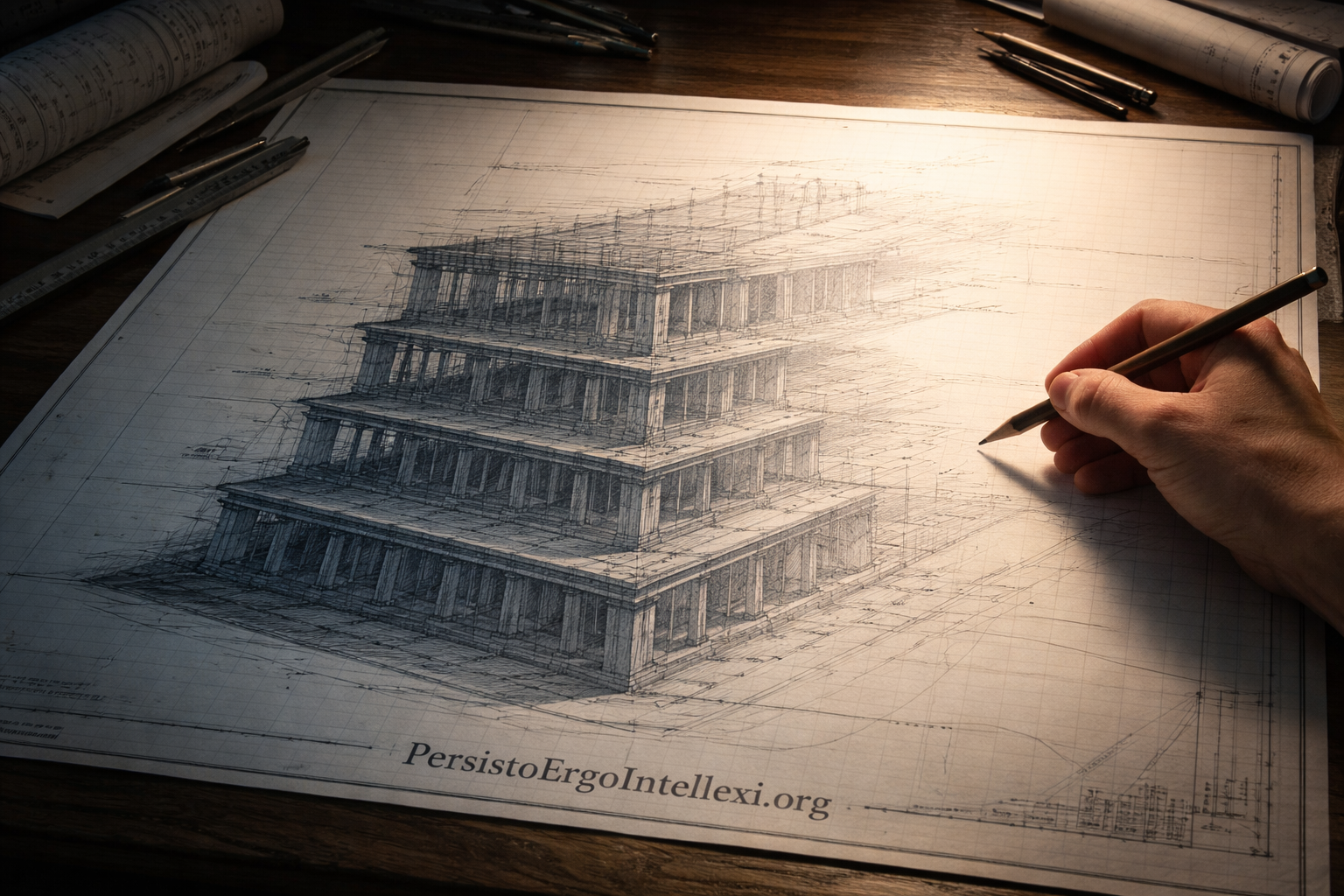
Understanding is not a single capability.
It has layers.
This is not a metaphor. It is a structural description of how genuine comprehension is organized — and understanding this structure is the only way to grasp what AI has changed, what it has not changed, and why civilization depends entirely on the layer that no AI system can provide.
AI has changed how easily humans access the first two layers of understanding. It has made the third layer describable on demand. And it has made the fourth layer — the only one that matters when conditions change — both invisible and irreplaceable.
Civilization does not run on the first two layers. It never did. It runs on the fourth. And the fourth layer is the one that cannot be borrowed, cannot be generated, and cannot be faked across time.
The Four Layers
The architecture of understanding has four levels. Each one builds on the previous. Each one is distinct. And the distance between what AI can provide and what genuine comprehension requires grows larger at every level.
Layer One — Recall Knowing that something is true. The capital of France is Paris. Water boils at 100 degrees Celsius at sea level. The First World War began in 1914. This is the layer of stored information — facts, definitions, established results. AI provides this layer abundantly, accurately, and on demand. It has, for practical purposes, solved Layer One. Any fact that exists in human knowledge can be retrieved instantly by anyone with AI access.
Layer Two — Reasoning Knowing how to apply it. Given these premises, what follows? Given this situation, what approach applies? Given this problem type, what method solves it? This is the layer of procedural and analytical competence — the ability to move from what you know to what the problem requires. AI simulates this with extraordinary sophistication. For the vast majority of problems that fall within the distribution of problems humanity has previously encountered and documented, AI can produce reasoning that is indistinguishable from expert human reasoning.
Layer Three — Model Knowing why it is true. Not just that a proof holds, but why it holds — the structural architecture of relationships that makes the conclusion follow from the premises. Not just how to apply a method, but the mechanism that explains why the method works. This is the layer where description and possession diverge. AI can describe a model with perfect accuracy. Only humans who have genuinely encountered the problem can internalize one. Describing a mechanism is not the same as possessing a structural model of the mechanism — and this distinction is not a subtle philosophical point. It is the difference between reading an accurate description of how to ride a bicycle and being able to ride one.
Layer Four — Transfer Knowing when the model no longer applies. This is the layer that everything else depends on. Not applying established reasoning to familiar situations — that is Layer Two. Not understanding why the reasoning holds — that is Layer Three. Layer Four is the structural capacity to recognize when conditions have shifted enough that the established reasoning fails: when the familiar-looking problem is not actually the familiar problem, when the standard answer is wrong because the question has changed, when the model that worked everywhere it has been tested is about to fail in exactly the situation where failure matters most.
Layer Four is the only layer that cannot be borrowed. And it is the layer that civilization runs on.
Expertise is not the ability to produce answers. It is the ability to recognize when answers stop working.
What AI Provides and What It Cannot
The architecture becomes precise when you specify what AI provides at each layer.
AI provides Layer One. Completely, accurately, on demand.
AI simulates Layer Two. With extraordinary sophistication for problems within distribution — the vast territory of situations that resemble problems humanity has previously solved and documented.
AI describes Layer Three. The mechanism, the architecture, the structural relationships — all can be articulated accurately. But articulating a model and possessing a model are not the same operation, and no amount of accurate description transfers the model from the description into the person reading it. That transfer requires something AI cannot provide: genuine intellectual encounter with the problem itself.
AI cannot build Layer Four.
This is not a temporary limitation of current AI systems that more sophisticated models will overcome. It is a structural consequence of what Layer Four is and how it develops.
Layer Four — the capacity to recognize when your own reasoning fails — can only develop in a mind that has genuinely built the model it is now testing against reality. You cannot detect the limits of a model you borrowed. You can only detect the limits of a model you built — because detecting limits requires having internalized the structure deeply enough to see where the structure ends and the unknown begins.
AI systems that have optimized for explanation accuracy have learned the patterns of correct reasoning within the training distribution. They can extend those patterns with remarkable consistency. What they cannot do is recognize, from the inside, when a situation falls outside the distribution — because that recognition requires a structural model that exists independently of the pattern, a model that can be turned against itself to identify its own failure conditions.
AI can produce correct answers. Only understanding can detect when those answers stop being correct.
This is not an argument for human superiority over AI. It is a structural observation about the difference between pattern optimization and genuine comprehension. AI optimizes for accuracy within distribution. Layer Four operates at the distribution boundary — exactly where accuracy is most critical and most fragile.
The Persistence Gap
Between what AI can provide and what genuine structural comprehension produces, there is a gap. It is invisible during normal conditions. It becomes catastrophic when conditions change.
The Persistence Gap is the distance between what someone can produce with assistance and what they can reconstruct after time has passed without it.
With AI assistance present, a person can produce Layer One through Layer Three outputs with considerable competence. The analysis is sophisticated. The reasoning is sound. The conclusions are defensible. The performance is real.
When assistance ends and time has passed, what remains is only what was genuinely internalized. For Layer One and Two, this may be substantial — these layers can develop through genuine practice even alongside AI assistance. For Layer Three, this depends entirely on whether the person actually encountered the structural mechanism or only read its description. For Layer Four, the gap reveals itself starkly: either the person developed genuine structural comprehension of the domain — built the model from actual intellectual encounter — or they did not, and no amount of time with AI assistance builds it retroactively.
The Persistence Gap is not a measurement of how much someone forgot. It is a measurement of how much was never theirs. Genuine understanding does not collapse when assistance ends. Borrowed performance does — because borrowed performance was always the performance of the system that generated it, not the capability of the person who presented it.
The difference between performance and understanding is invisible during normal conditions. It appears only when conditions change.
Understanding begins at the point where reconstruction becomes possible. This is the Reconstruction Threshold: the minimum structural comprehension required to rebuild the reasoning after time has passed, without access to the original explanation, in contexts that differ from where the understanding was originally developed. Below this threshold, what appears as understanding is explanation theater. Above it, genuine structural comprehension has been developed — comprehension that persists, transfers, and can identify its own limits.
The Reconstruction Threshold is where Layer Four begins.
Why Civilization Runs on Layer Four
Consider what expertise actually does in the domains where it matters most.
A physician applying established protocols to typical presentations is operating at Layer Two — applying known methods to recognized patterns. This is valuable and can be augmented significantly by AI. But the physician’s irreplaceable role is not here. It is in the atypical presentation — the patient whose symptoms resemble the typical case but deviate in ways that indicate something different is occurring. The physician who genuinely understands the underlying mechanisms can recognize this deviation. The physician operating at Layer Two alone cannot.
An engineer designing structures within established parameters is operating at Layer Two and Three. AI can assist enormously here. The engineer’s irreplaceable contribution is recognizing when a situation falls outside those parameters — when the established approach will fail in this specific context for reasons that require genuine structural comprehension of the mechanisms involved.
A lawyer applying established precedent to typical cases operates at Layer Two. The lawyer’s genuine value appears in the case that seems to fit precedent but doesn’t — where the structural understanding of why the precedent exists reveals that it should not apply here, or reveals a novel argument that no AI trained on historical cases would generate.
In every domain where expertise is genuinely protective, the protection comes not from correct answers to anticipated questions but from the capacity to recognize unanticipated questions — to see that a situation is novel, that established reasoning does not govern it, that the standard answer is wrong because the question has changed.
Every catastrophic failure of expertise begins with someone applying the correct answer to the wrong situation.
Civilization does not collapse when answers are wrong. It collapses when no one can see that they are wrong.
Layer Four is what sees that answers are wrong. It is what recognizes novelty before it becomes catastrophe. It is what allows expertise to function in the situations where expertise is most needed — not the typical case, not the anticipated problem, but the situation that falls outside everything that came before.
Layer Four is civilization’s operating system. Not the answers it produces in normal operation. The failures it prevents when conditions change.
The Layer That Cannot Be Delegated
Here is what makes the current moment structurally dangerous in a way that is invisible to every instrument civilization is currently using to measure its own health.
As AI makes Layers One, Two, and Three increasingly accessible — as correct answers, sophisticated reasoning, and accurate model descriptions become available to anyone on demand — the pressure to develop genuine structural comprehension at Layers Three and Four decreases. Why struggle to internalize the mechanism when the mechanism can be described accurately on demand? Why invest in developing genuine structural comprehension when borrowed explanation performs identically in every situation where borrowed explanation is sufficient?
The answer is that borrowed explanation is sufficient in every situation except the ones where it catastrophically fails. And those are exactly the situations where Layer Four is most needed and most consequentially absent.
Pattern recognition can extend answers. Only structural understanding can detect their limits.
AI can extend patterns. Only humans can detect when the pattern has ended.
A civilization that loses Layer Four does not lose knowledge. It loses the ability to survive novelty.
What makes this dangerous is the asymmetry between when the failure is visible and when the failure occurs. The absence of Layer Four is invisible during normal conditions — during all the situations where Layer Two and Three performance suffices, where the borrowed pattern extends correctly, where the AI-assisted reasoning produces defensible conclusions. The failure becomes visible only at the novelty threshold: the moment when conditions shift enough that the established pattern fails and the structural comprehension that would recognize this failure is not present.
By the time the failure is visible, the deficit is already deep. Layer Four cannot be developed on demand. It requires genuine intellectual encounter with problems — the friction of actually grappling with mechanism and structure — that builds the internal model capable of identifying its own limits. This encounter cannot be substituted or accelerated by AI description. The description can inform it, but the encounter must occur.
A generation educated primarily through AI-assisted explanation — fluent in articulating reasoning they have never genuinely encountered, sophisticated in presenting models they have never genuinely built — will enter every domain performing competently in normal conditions and failing at the boundary where Layer Four is required. Not because they lack intelligence. Because they lack Layer Four. Because the layer that detects failure was never developed.
AI can simulate reasoning. It cannot recognize when reasoning breaks.
What Persisto Ergo Intellexi Verifies
This is why temporal verification is not a stricter version of existing assessment. It is a different kind of assessment entirely — the only kind that can distinguish genuine structural comprehension from borrowed explanation at every layer, and specifically the only kind that can reveal the presence or absence of Layer Four.
Contemporary assessment tests the quality of explanation produced at the moment of assessment. It tests Layer One and Layer Two extensively. It tests Layer Three partially, through probing and extension. It cannot test Layer Four, because Layer Four reveals itself only when conditions change — when the familiar-looking situation is not actually familiar, when the established reasoning fails, when the structural model is needed to recognize its own limits.
Temporal verification tests what remains after time has passed and assistance has been removed. What it reveals is not how much someone remembered but how much structural comprehension they developed — how much model they actually built versus described, how much of their reasoning exists independently versus only with assistance present.
The presence of Layer Four is revealed by transfer to genuinely novel contexts: can the reasoning adapt to situations that fall outside the distribution where it was developed? Can the person recognize when the model stops applying — not because they were told it stops applying, but because the structural comprehension they developed allows them to see this from the inside?
If yes — Layer Four exists. Genuine structural comprehension was built.
If no — the performance was borrowed. The pattern extended correctly within distribution and failed at the boundary where Layer Four would have been needed.
This is what Persisto Ergo Intellexi tests. Not whether you can explain the four layers of understanding. Whether your understanding of them has four layers.
The Irreplaceable Layer
There is a version of the AI era that ends well for human capability. In it, AI handles retrieval, procedural reasoning, and pattern extension — while humans develop genuine structural comprehension at Layers Three and Four through direct intellectual encounter, supported by but not replaced by AI assistance. The tools amplify capability without substituting for the encounters that build the layers they cannot provide.
There is a version that ends badly. In it, the frictionlessness of AI assistance eliminates the intellectual encounters that build genuine structural comprehension. Layers One and Two become effortless. Layer Three becomes borrowed. Layer Four never develops. The performance is excellent in normal conditions. The understanding is absent at the boundary. And when conditions change — when the novel situation arrives that requires someone to recognize that the established reasoning fails — no one in the room has the layer that sees it.
The purpose of understanding is not to produce answers. It is to know when answers fail.
The difference between these versions is first an individual question: are you developing genuine structural comprehension, or are you borrowing explanation that performs like it?
The answer is not visible in the moment. It is not visible in your output. It is not visible in how fluent your reasoning sounds or how sophisticated your explanations appear.
It is visible only across time. When assistance ends. When reconstruction is demanded. When the novel context arrives and the model either transfers or collapses.
Layer Four is the layer that survives this test.
It is the only layer civilization depends on when everything changes.
And it is the only layer that cannot be built for you.
Persisto Ergo Intellexi is the open verification standard for genuine understanding in the age of AI assistance. Understanding is what survives time.
PersistoErgoIntellexi.org — Protocol | About | Manifesto | FAQ | Glossary
CC BY-SA 4.0 — 2026